
Lent is traditionally seen as a time of self-
torment and asceticism (http://tr.im/gLxW). A true ascetic would
probably look unfavorably on our American eating and entertainment
habits. In the evangelical church, asceticism is not really seen as a
part of Christian living and therefore Lent is not something regularly
observed, talked about, or even mentioned. "Isn't Lent what
undershirts leave in your bellybutton?" Right.
However, our church has recognized that there is such a thing as Lent
this year, l a booklet leading us to pray for revival in these
forty days. I have been thinking about what possible connection there
could be between Lent and praying for revival. Lent is traditionally
a time of introspection and abstinence. What does that have to do
with praying for revival?
Here's my assessment. There actually is a good connection between the
two, but it really depends on your definition of revival.
1. Revival: "a reawakening of religious fervor, esp. by means of a
series of evangelistic meetings."
2. Revival: "a restoration of... life or consciousness."
The first is focused on two things: fervor and meetings. That kind of
revival, unfortunately, has become the quiet dream of many evangelicals.
The second revival simply talks about life. Something is dead or
unconscious and needs to be revived. The need is assumed in the
beginning of the word: "re". Something needs life again. In this
sense of the word, revival fits very well with Lent. If we do not set
aside serious time to abstain from things like food and entertainment,
we will never notice if, spiritually, we are unconscious. I am not
praying for fervor; it is that very religious fervor that has often
blinded me to my own deficiency... that kind of fervor that is best
expressed in evangelistic meetings. During Lent, our fervor should
be humbly seeking to be slapped in the face, to be woken back up from
lethargy. The monks and ascetics did get one thing right: true
revival begins in quietness.
Wednesday, February 25, 2009

Thursday, February 12, 2009
Economy, Postmodern, and Babel
 So we have a President in office who is essentially Keynesian (ok, neo-Keynesian); who believes that the economy can not right itself but the government can. Therefore, we are, as John McCain describes, stealing trillions from future generations of Americans. However grossly oversimplified my Keynesian definition, it does bring up an interesting question: "How the heck did American get here again?"
From what I have seen, most media have focused exclusively on the last 15 years in the housing/lending/banking industry, trying to make sense out of the last few steps that led us (excuse my terminology) "over the cliff."
I am more interested in the long view... who cares about the last few steps? How did we get on this road? Were there any signs saying, "Cliff ahead!" or "Watch out, road appears to be going up a glorious hill but suddenly ends"?
I have no problems with capitalism... however, capitalism is only as perfect as the humans who comprise each economy. As a nation, we are suddenly seeing the great benefits of swift action, and many have begun to say, like ancient Israel, "give us a king!" And our President has tried to perform as swiftly as a king could, but alas, he can not. In the reality of the endless beauracratic halls of our complex system of government, we have lost our ability to respond to anything very quickly.
The economic dream of America reminds me of two things... the modern dream of progress, which in turn reminds me of the tower of Babel. Many of us Christians have bought into this dream, that, believing in the ultimate goodness of man, we can somehow manage a meager American utopia... we call it the American dream. Yet, as they found in Babel, God is not always interested in fulfilling our dreams if He isn't in the ending.
[Picture from flickr martinstelbrink]
Sunday, February 8, 2009
Greatness: How many people have to know you're great for you to be great?
 I am married but do not have kids, and I have been thinking about the deeper things of life... mainly, what kind of father will my kids remember? What makes a man great, and what measures his impact on the world?
And in thinking about these deep things, I have realized something about myself... I have measured greatness in numbers for most of life, subconsciously. But, how many people have to know you are great before you are great? (yep, it's a rhetorical question)
This is actually one of the positive things that postmodernism makes room for. The modern ideology stated that greatness was measured by numbers and breadth of influence. It's vision relies on great men with great power impacting great masses of humanity. Postmodernism is doubt of the modern. So, here is one way I am postmodern... I doubt that greatness has anything to do with many people knowing about it.
A lot of people are afraid of postmodernism because it is often inherently mystic, finding meaning in spiritual, undefinable things. Most people fear the undefinable, fearing that anarchy is inevitable. But it is true that greatness is truly, at the core, something spiritual, undefinable, and ultimately local... and most often, a person's greatness is most evident in the most secret places. The people I consider great aren't necessarily the people reaching thousands, millions... most of them are just incredible parents, friendly neighbors, and people who do good in secret.
Postmodernism is open to life lived locally, open to the simplicity of being tied to the earth (agrarianism); it doubts the machine of progress and re-opens the question of simple being.
Just one more reason I use the controversial title Postmoderner. I'm convinced there are ways that postmodernism can help Christianity relocate its vision of the Kingdom of God.
Friday, February 6, 2009
Cool vs. Relevant

In response to the Relevant magazine article "Moving Beyond Postmodernism" by Joey Berrios. (link)
I still wonder what people are referring to when they refer to "postmodern culture". I have read plenty about postmodernism and plenty of post-modern philosophy. None of it suggests to me that there is a culture or group of people out there that could be called "postmodern." Obviously, not very many people share this sentiment, even though no one could accurately define who is post-modern and who is not. I think it confuses things much more when the Church claims to be responding to this ghost-culture! But that's a different issue.
Nonetheless, Berrios's article makes some great points... let me stick to one of them. Cool vs. Relevant.
When I ask people, "What is postmodernism?" the most common response I get has something to do with the relativity of truth; everyone gets to believe what they want to believe because in the end it's just belief anyway... nothing more. Ironically, the "postmodern church" has responded by trying to be cooler. I fail to see how this approach correlates to our definition of postmodern culture. Of course, they would not say cool, they would say relevant. I would call Starbucks in church lobby's a pretty obvious attempt at branding the church. To me, relevance has nothing to do with image... I mean, true relevance. Berrios makes a great point: "Jesus is relevant to culture" but not really cool. And by 'cool', I am talking about whatever is really hot right now. Whatever you want to call the culture out there, I think there is one way for it to be apparent to them that we are authentic:
Entrust our reputation to the Father, sort of like what Jesus did.
Yeah, I'm pretty much against this thing called image-management, right now. I just do not see where Jesus was that concerned about His reputation. I mean, what did He think upturning all the tables in the temple would look like? It certainly was not an image-polishing stunt. Yet, if we, the Church, ascribe to this marketing formula of putting on our best face in the public eye, carefully managing our image, when will we have time to manage our substance? Jesus put so much time into managing His substance, His character, and helping others do the same, I am not sure He had time to worry about His image. That's real. That's bold. Just like so many other great Christian truths, it's the last thing you would expect to work.
But it does. Obviously. Therefore I agree with Berrios: let's move on from postmodernism! Really, it's a distraction for the church. If you want to talk about philosophy, that's one thing. If we are talking about being Christ-followers, let's not dress it up in the latest fashions. Simple orthodoxy is good enough for me.
Wednesday, January 7, 2009
TwitterJesus
 I was curious to see how much the word "Jesus" was on Twitter compared to some other words... interesting results.
The fact that Twitter exists and is a growing phenomenon could mean several things. A) All we Twitterers are just self-obsessed, hoping to gain as much attention to our daily minutia as possible. B) Twitter really is a great marketing, PR tool. C) Twitter is just another cultural reality illuminating itself in cyberspace... the reality of constant connectivity.
I lean toward C.
Twitter is about the act of Tweeting.... which in non-Twitter terms simply translates "adding your voice to the chorus of other voices". It's a constant conversation.
More on Twitter and Jesus later.
Thursday, November 6, 2008
Party politics and Christianity

conservative, etc. We're in trouble if we as Christians start to
view one as more Christian than the other. I've heard so much in
recent days about both McCain and Obama from Christians that seem to
suggest that Christianity always picks a side and fights for it.
Sorry, but I just don't see that in the Bible.
Here's my brief thought on politics... if postmodernism has any good
side to it, it's this: it can help us appreciate other ways of
interpreting the world, even inside our Christian faith. It at least
acknowledges that there are often more than one way to view things,
more than one interpretation. If we are humble, postmodernism can
correct our dogmaticism a little. I think believers in Christ have
to be careful to first represent who Jesus is, and then humbly hold
to their own opinions. In the heavily mediated society we live in,
KNOWING is hard; we need more humility in our approach to
interpreting the reality around us, especially political reality.
Otherwise, we'll just pick a side and join the shouting match.
Thursday, October 23, 2008
In-your-face Online Pastoring: Porn-Again Christian

about porn and Christian young men. (click on pic above) Besides the need for this
kind of honest approach from Christian leadership, this is also a
good idea because it's free but not pushed in your face... you have
to choose to access it. Pastors in this age need to be creative in
getting God's culture-ideas into the hearts and minds of this
generation... and Mark D. is doing it!
Intuitive computing: speaking into the cloud

Could the future of laptops do away with keyboards? I think so, and I don't think it's very far away. [This picture was found anonymously on some server; it looks like a prototype fusion of a Macbook and an iPhone.]
A couple technologies are really being fine-tuned right now that are
preparing the way for small but completely functional mobile computer/
phones. One is the concept of "cloud computing," where most
information is not stored on the pc anymore but, instead, online.
This allows for devices to be more like windows to knowledge than
warehouses for it. Second, voice-recognition software is getting so
adept that in 10 years typing will be as ancient as typewriters (my
prediction). At least, they will be second place to voice-reg, only
used for privacy.
So here's the central idea behind this post... technology is mimicing
human intuitive practice... touch, speech, etc. Instead of us having
to adapt to technology, technology is adapting to us, so we don't
have to learn how to type or create code. We simply speak to our
device which takes our speech into the air where our ideas float
around and are mixed with millions of other ideas. Anyway, it's
worth keeping an eye on.
Tuesday, October 21, 2008
New Kinds of Knowledge: The Internet as a Source of Qualitative Study

A new field of qualitative research may be emerging from the marketing/computer science sector. Tags, metatags, and user descriptors on the Internet are creating huge fields of data for researches to study trends and mass user opinions. So, in normal every day terminology, there could be an actual academic approach to studying user behavior on the Internet besides just statistics. Studying trends in the market by qualitatively analyzing tags is bound to transform mass media studies. [Thanks to a new favorite blog, thetrendwatch.com]
Thursday, October 9, 2008
Text in church?
Last year, at the Future of Television conference in New York City, audience members could ask questions... and not just in your normal pick and point method. There were several hundred people at this conference! Actually, any person in the audience, at any time, could simply pick up their phone and ask a question via SMS. The questions would be filtered by someone with incredible wisdom and tech savvy, and some questions would be posted to a screen where everyone at the conference could see... prompting the speaker to respond if the audience felt it was a good question.
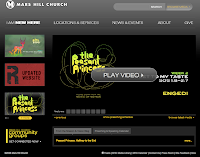
While this is supposedly cutting-edge, I found out that churches are already doing this! Mars Hill has supposedly done this in their youth services, while a church outside of St. Louis is using SMS in their main service. (Check out the article!) So here's the "postmoderner" question: how is this going to change the dynamic of preaching in the next 10-20 years if this catches on? Think of it! People can ask questions, get involved... and unavoidably, talk to each other during the service! It signifies the battle between inner reflection and constant connection... and yet, transforming the Sunday morning sermon into a conversation might just be the openness outsiders are looking for.
While this is supposedly cutting-edge, I found out that churches are already doing this! Mars Hill has supposedly done this in their youth services, while a church outside of St. Louis is using SMS in their main service. (Check out the article!) So here's the "postmoderner" question: how is this going to change the dynamic of preaching in the next 10-20 years if this catches on? Think of it! People can ask questions, get involved... and unavoidably, talk to each other during the service! It signifies the battle between inner reflection and constant connection... and yet, transforming the Sunday morning sermon into a conversation might just be the openness outsiders are looking for.
Friday, September 26, 2008
Original intent
When it comes to the Constitution of the U.S., most American Christians are quite adamant about how it is interpreted. Most would insist that we should follow the original intent of its creators, and it is no different for judicial law, which seeks to protect the law from distorted variations of that intent. (This article is a good example... http://www.worldnetdaily.com/news/article.asp?ARTICLE_ID=29647)
Many Christians would argue that the original meaning of the Bible is preserved throughout time and through the process of interpretation and cultural change... the Word is preserved. It may be true that truth is preserved, but how easy is it to find that truth? Many assume the Bible can be taken at face value. I believe that, for much of the Word, this is true. But it is also dangerous to assume that we understand or that the truth is there, plain to see. Every text, even the Bible, requires that every reader interpret its meaning through their own eyes and in the context of their own experiences.
So, what model of approaching Scripture will work? If the truth is not always apparent, how do we know original intent? And is the key to all things in that intended meaning?
The Big Switch
Some people would say that the switch from modern thought to postmodern thought was a big switch. Others would say it is still happening. Either way, it intrigues how that switch might play out on the Internet... not so much "Is the Internet a product of this switch?" but... "Can we observe culture change via how people use it?"
Nick Carr thinks we can... he wrote a book called The Big Switch (no, it's not my term) and his basic premise is that the Internet is changing culture. How? Carr stated on the Sept. 25th "Colbert Report" (http://www.hulu.com/watch/36717/the-colbert-report-thu-sep-25-2008) that we are now beginning to think like the Internet in that we are simply open to the random updates and constant buzzing of meaningless/ful news and incessant option of the Internet. So, we're losing our ability to concentrate. As ridiculous as it might sound off the cuff, it gives me pause because I do find it a lot harder to settle down and just read a book or contemplate and write/journal.
Of course, the younger you are, the more this applies to you. Whether it's happening to you or not, it is happening to the lion's share of a generation, and Christians are gonna have to figure out how to communicate the timeless values of listening, waiting, meditating... no worries, though. I think there will plenty of people hungry for a bit of inner sanctum.
Subscribe to:
Posts (Atom)

 Posts
Posts


